

 Destinations Menu


 RSS
RSS


Best of Florence: Top 10 Attractions in Florence
Florence is literally bursting with places of visitor interest, particularly in the realm of art and architecture. There are scores of impressive medieval palazzos (palaces) and piazzas (public squares) throughout the city, together with museums and galleries filled to the rafters with monumental collections of art and antiquities, enough to overwhelm even the seasoned tourist. So, you might ask, what should one see in this Renaissance city? Well, here are the top 10 attractions of Florence.
[ Related pages: Florence, Italy and Best Art Museums of Florence ]
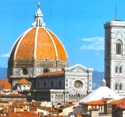 Piazza del Duomo
Piazza del Duomo, in the heart of the historical district, is the city's most famous square. It is dominated by the Cupola Duomo, Florence's pièce de résistance, a landmark cathedral with a massive ochre dome designed by Brunelleschi and visible from virtually every vantage point in the city.
 Galleria degli Uffizi
Galleria degli Uffizi, the largest and most prestigious art museum in Florence, has a monumental collection that covers virtually every art movement in Italy and throughout Europe. Crammed with priceless works in 45 rooms in two galleries, plus an historic corridor, it is a place not to be missed.
 Palazzo Vecchio
Palazzo Vecchio, a 14th-century military-style medieval town hall with crenelations and a 308-foot tower, built in massive fort-like dimensions, is worth seeing. Its interior walls are adorned with Vasari's frescoes depicting the history of the ruling Medici family.
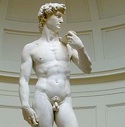 Galleria dell’Accademia
Galleria Dell-Accademia is the second-most visited gallery in Florence. It has seven famous marble sculptures by Michelangelo, including his renowned David. The gallery also houses a fabulous collection of paintings by Benozzo, Gozzoli, Botticelli, Fillippino Lippi, Perugino, and others.
 Piazza Repubblica
The Piazza Repubblica is one of the most impressive public squares in the center of Florence, hugely popular with tourists. A great place for an espresso and pastry, it is populated with historic cafés that drew writers, artists and intellectuals of the 19th century.
 Museo Nazionale del Bargello
Florence's National Museum, housed in the 13th-century Palazzo Bargello, has an outstanding collection of Renaissance sculpture, including Michelangelo's first major piece, Bacchus, as well as works by Ghiberti, Donatello, Brunelleschi, Verrocchio, Cellini and Giambologna.
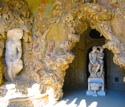 Giardino di Boboli
Giardino di Boboli, located in the hilly area behind the Palazzo Pitti, is Florence's most famous public garden and one of the best examples of Italian landscaping. There are fountains, grottoes and scores of astonishing sculptures. The garden's ancient amphitheater is where opera was born.
The Oltrarno
Of all of Florence's neighborhoods, the Oltrarno is singularly the most picturesque and most colorful. Situated on the south side of the River Arno, it is a warren of narrow, winding, cobbled streets filled with antique dealers, artisan workshops and great restaurants. Here are the last vestiges of Florentine culture.
 Piazzale Michelangelo
Piazzale Michelangelo has the city's best viewpoint, with a sweeping panorama of Florence, especially lovely at sunset. This is a popular tourist stop, crowded with souvenir dealers. There's also a bronze replica of Michelangelo's David here.
 Ponte Vecchio
Ponte Vecchio (Old Bridge), located near the Mercato Nuevo, offers in it the classic Florentine view. It is an outstanding example of medieval bridge architecture, dating from 1345. In the quarters at the bridge are jewelry traders who have plied their trade here since the 17th century.
© Indian Chief Travel Guides


Ischgl is a small mountain village turned hip ski resort, with massive appeal among the party-hearty young crowds. It is... Read More

Andorra la Vella is its own little world, and not just because it’s a 290-square-mile independent principality (a fifth the... Read More

Bariloche (officially San Carlos de Bariloche) is the place to be seen. It is to Argentina what Aspen is to the... Read More

Aspen is America's most famous ski resort. And that's an understatement. For, as a ski complex, Aspen is unsurpassed. Its... Read More

Zermatt is a small but glamorous mountain resort town, with a population of approximately 5,700. It is one of Switzerland's... Read More

St. Moritz is a glitzy, alpine resort town in the celebrated Engadin Valley of Switzerland, with huge notoriety as the... Read More

Lake Tahoe is the premier lake resort of America, and the largest alpine lake in all of North America. It is an absolutely... Read More

St. Anton, Sankt Anton am Arlberg in German, is Austria's premier ski-bum resort! It's actually a small village cum... Read More

Kitzbühel, a small, Tyrolian resort town in the Kitzbüheler Alps, comes with international renown and huge snob appeal, and... Read More